


 Make an appointment
 Buy a gift card
 Find a branch
 Reload a gift card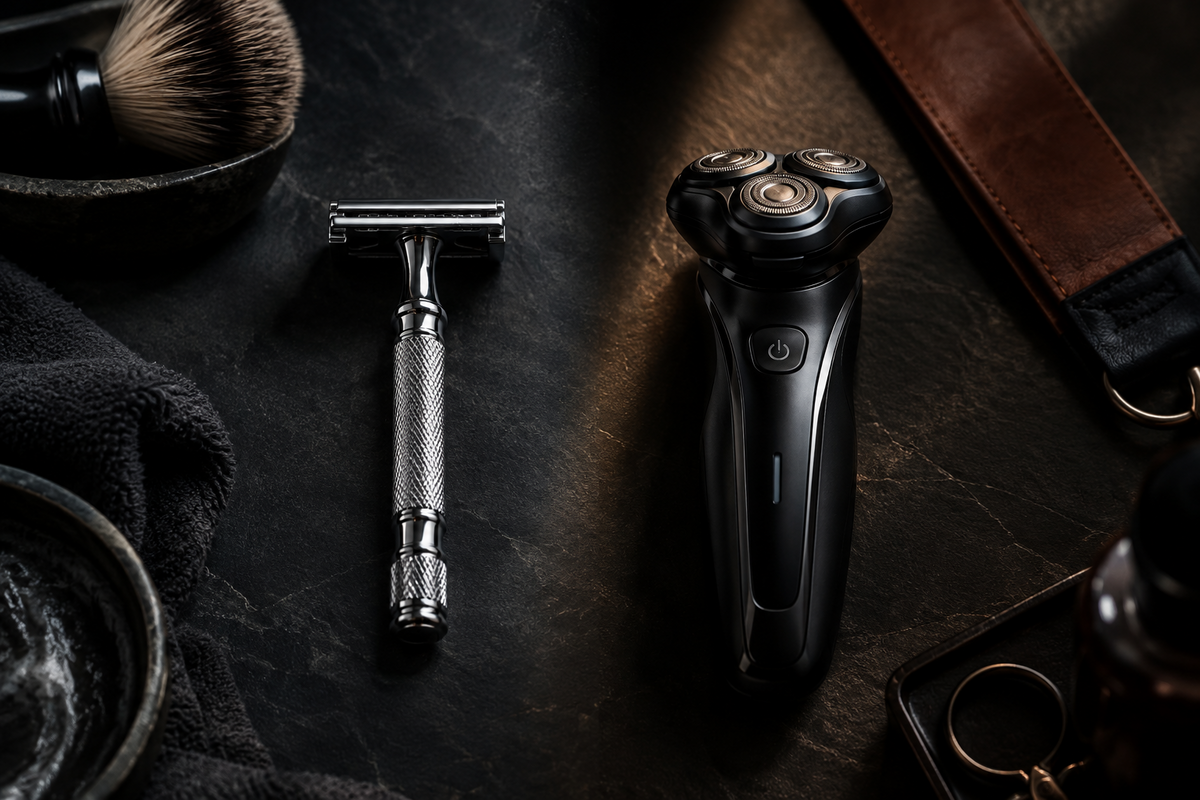
If you're after the closest shave, the lowest long-term cost, and the gentlest result on your skin once the technique is learned, the safety razor wins. If you want speed, dry shaving, or a short beard kept tidy between full shaves, the electric shaver is more practical. The right choice depends less on the tool than on your routine: the time you have in the morning, your skin type, your budget and how often you travel.
Here's how to decide based on your daily life, without getting it wrong.
The real difference: where the blade meets the skin
A safety razor glides a single double-edge blade directly over the skin. It cuts the hair flush with the surface, leaving skin that feels smooth, often for more than 24 hours.
An electric shaver, by contrast, cuts the hair through a very thin metal foil. The blade never touches the skin directly. The shave is faster and carries no risk of cuts, but it leaves a slight shadow, because the foil keeps it from getting as low as a blade does.
Everything else follows from this difference: closeness, time, irritation, cost.
Safety razor vs electric shaver: the comparison
| Criterion | Safety razor | Electric shaver |
|---|---|---|
| Closeness of the shave | Very close to the skin, smooth finish | Clean, but a slight shadow remains |
| Time per shave | 5 to 15 minutes including preparation | 2 to 5 minutes |
| Learning curve | A few weeks to master the angle | Almost none |
| Risk of cuts | Low with good technique | Almost none |
| Long-term cost | Very low: blades at roughly $0.20 to $0.80 each | Foil and cutters to replace periodically |
| Sensitive skin | Excellent if the razor and blade are well chosen | Good, especially for dry shaving |
| Dry shaving | Not possible | Yes |
| Lifespan | Decades for a metal razor | Several years, depending on the battery |
Which shaver to choose based on your lifestyle
You're rushed in the morning
Between packing lunches, the kids and traffic, every minute counts. The electric shaver wins here without debate: no lather, no rinsing, and you can even shave dry. To get the most out of each method, our article on dry or wet electric shaving details the results of each.
That said, a well-practiced safety razor shave doesn't take much longer than people think. Once the technique is second nature, many men do it in under ten minutes, in the shower or right after.
You want the closest shave possible
A job interview, a wedding, a photo, or simply the pleasure of perfectly smooth skin: the safety razor delivers a result no electric shaver matches. The blade cuts the hair at skin level, with no shadow. That's also why barbers finish contours with a blade.
You have sensitive skin or ingrown hairs
This is where misconceptions are the most stubborn. People often think electric is gentler, but that isn't always the case. The repeated rubbing of the foil can irritate, especially on the neck. A closed comb safety razor, used without pressure and with the grain, often causes less redness, because only one blade passes over the skin. An adjustable razor like the Rockwell 6S also lets you start gentle, then increase aggressiveness as your technique improves.
Preparation also makes an enormous difference. A well-lubricating shaving cream protects the skin and reduces friction on the blade, which extends its life. If irritation persists, our article on how to avoid razor burn will help you find the cause.
And for the small cuts of the early days, a styptic pencil stops the bleeding in seconds, while an alum block soothes the skin and tightens pores after shaving.
You're watching your budget
Over several years, the safety razor is unbeatable. A good razor costs $40 to $150 and lasts a lifetime. After that, all that's left is the blades, which cost a few cents each. Changing blades every five to seven shaves, a man who shaves every day generally spends $15 to $40 a year on blades. To know when to replace yours, see our guide on how many times you can use a razor blade.
An electric shaver requires a higher upfront investment, then replacement of the foil and cutters when they wear out. A quality device stays worthwhile if well maintained, but it will never match the running cost of a double-edge blade.
You travel often
Both travel well, with one important caveat for flying. According to Transport Canada's list of prohibited items, razor blades are not allowed in carry-on baggage. With a safety razor, pack the blades in your checked bag. An electric shaver, on the other hand, travels in the cabin without a problem, and a cordless model saves you from hunting for an outlet at the hotel.
If you want to keep traditional shaving on the road, a compact model like the Merkur 933 travel razor slips easily into a toiletry bag.
You wear a beard and maintain outlines
If you keep a short beard or three-day stubble, a foil electric shaver is handy for quickly cleaning up the cheeks and neck. For a truly sharp outline, though, the blade remains more precise. Many men combine the two: electric for bulk, safety razor for the finish.
And why not both?
It's often the most realistic solution. The electric shaver on weekdays, when time is short. The safety razor on the weekend, when you can take ten minutes for a full, careful shave. This combination gives you the best of both worlds, and it lets you learn the traditional technique without pressure.
If you lean toward electric, our professional-grade foil electric shavers are the ones barbers use for finishing work. And if you're torn between technologies, our comparison of foil vs rotary electric shavers will help you choose.

Making the jump to a safety razor? Choose the right type
Not all safety razors are equal for a first try. A model that's too aggressive can turn your first shaves into a bad memory, while a closed comb razor gives you time to learn. Our guide to the 4 types of safety razors and how to choose the right one explains the differences between closed comb, open comb, slant head and adjustable razors.
Think about the blade too. To start, a mild or medium blade is more forgiving of mistakes. Japanese blades like the Feather New Hi-Stainless are remarkably sharp and suit dense beards better, once your technique is mastered.

Frequently asked questions
Which razor shaves the closest?
The safety razor. Its blade cuts the hair at skin level, whereas an electric shaver's foil always leaves a small length. The difference shows most at the end of the day.
What are the drawbacks of an electric shaver?
It shaves a little less closely, costs more to buy and requires replacing the foil and cutters over time. Its battery also wears out after a few years. On the other hand, it is fast, carries no risk of cuts and can be used dry.
Is a safety razor dangerous?
No. Its name comes precisely from the guard bar that only exposes a small portion of the blade. Cuts happen mostly at the start, when you press too hard or hold the razor at the wrong angle. With a little practice, they become rare.
Can you rotate a double-edge blade 180°?
Yes, some traditional shaving enthusiasts do. It isn't about flipping the razor in your hand during the shave (you naturally use both edges that way), but about removing the blade after a few shaves and refitting it rotated 180°, so the other end faces up. The cutting angles and micro-wear are then spread a little differently, which can give you one or two more comfortable shaves. Some people mark one corner of the blade to keep track of the rotation.
Keep in mind, though, that it isn't a fresh blade: both edges have already been used and the gain remains modest. Handle the blade carefully, holding it by the short sides.
How long does a safety razor blade last?
Generally, five to seven shaves. A thick beard shaved daily can bring that down to three or four. As soon as the blade pulls instead of cutting, it's time to change it. Flipping the razor in your hand doesn't change that count: you already use both edges of the blade with every shave.
Speed or precision, convenience or savings: the right razor is the one that fits your routine. If you want to try the closest, most lasting shave, discover our selection of safety razors and find the model that suits you.


