


 Make an appointment
 Buy a gift card
 Find a branch
 Reload a gift card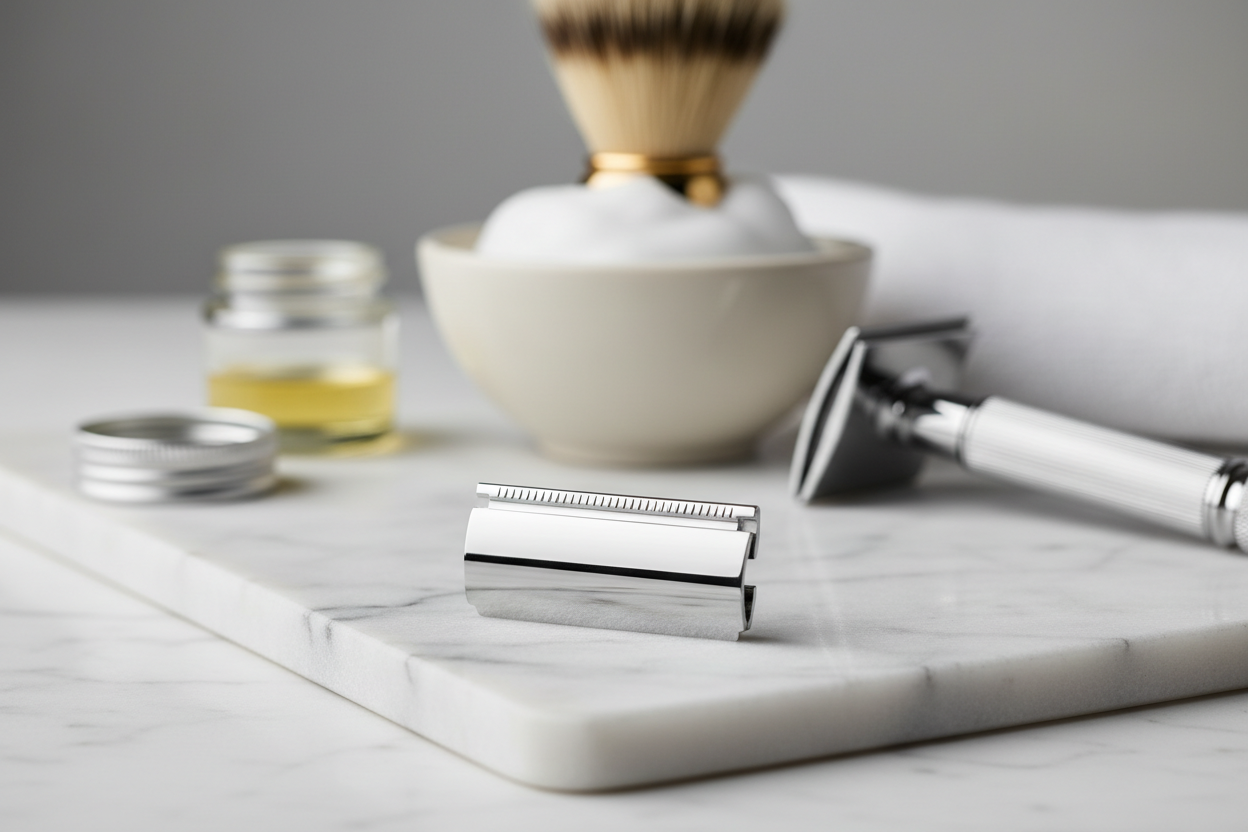
The short answer: it depends. The helpful answer: 3 to 10 times for a double-edge blade, 5 to 15 times for a cartridge, with significant variations depending on your beard, skin, and even the water quality at your home. Here's how to accurately know when to change yours.

There's no universal number, and that's normal
Manufacturers provide broad numbers because they have to. Gillette mentions a month of use. Wilkinson quotes 10 shaves. These indications apply to a fine beard shaved daily under good conditions. For a thick beard with hard water, it's a different reality.
What truly makes a difference is the combination of four variables: the type of blade, the hardness of your beard, the frequency of shaving, and how you maintain your blade between uses.
By blade type: practical benchmarks
The double-edge (DE) blade
This is the format slipped into a safety razor. The edge is very thin, thus more susceptible to dulling. An economical blade (Derby, Tiger, Bic) generally lasts 2 to 4 shaves before starting to tug. A mid-quality blade (Astra, Nacet, Shark) lasts 4 to 7 shaves properly. The best blades (Feather, Gillette Nacet Platinum) can last up to 7 to 10 shaves with a fine beard.
Consult our razor blade selection to compare available formats for your use.

The cartridge blade (Gillette, Wilkinson, etc.)
Multi-blade cartridges last longer in use because the blades are better protected and their geometry distributes pressure more effectively. In practice, 5 to 10 shaves is a realistic range for most men. Some go up to 15 to 20 with a fine beard and soft water. But many men keep them too long precisely because they are expensive: a Gillette Fusion5 cartridge costs between $4 and $6 at Jean Coutu or Pharmaprix, which creates a natural reluctance to change it too soon.
The disposable razor
Designed for 1 to 3 shaves. Beyond that, it's uncharted territory. The metal and protection are inferior to a quality razor. Keep them for emergencies, not for a daily routine.
How water hardness changes things
This is the least known factor, but it is real. Hard water, very common in certain regions of Quebec, leaves limescale deposits on the blade after each rinse. These deposits significantly accelerate dulling.
If you live in a hard water region and your blades seem to degrade faster than usual benchmarks, it's not just an impression. A simple trick: after each shave, gently wipe the blade on a dry towel in the direction of the edge (never against it) to remove moisture and residue before they dry on the metal.
How to read the signs that a blade needs changing
Forget the calendar. The best indicator is the sensation during shaving.
A blade in good condition cuts effortlessly. It glides, doesn't catch, and provides a clean result quickly. A dull blade tugs at hairs rather than cutting them. You feel friction. You go over the same area two or three times. After shaving, you have redness or a burning sensation, which is unusual.
This is the clearest sign: if shaving hurts or tugs, the blade is finished. Continuing to use it doesn't save you anything—the result will be poor, and your skin will suffer.
Another less obvious sign: if you see rust on the blade, it goes straight to the trash, no discussion. Rust is not only unsightly, it increases the risk of irritation and infection on micro-cuts from shaving.
Shaving frequency changes everything
| If you shave | Change your DE blade | Change your cartridge |
|---|---|---|
| Every day | Every 5 to 7 days | Every 1 to 2 weeks |
| Every 2 days | Every 1 to 2 weeks | Every 2 to 3 weeks |
| Twice a week | Every 2 to 3 weeks | Every 4 to 6 weeks |
| Once a week | Every 3 to 5 weeks | Every 6 to 8 weeks |
These benchmarks are for a normal beard under standard conditions. Adjust downwards if you have a thick beard or hard water, upwards if your beard is fine and your water is soft.
Can you extend the lifespan of a blade?
Yes, with a few simple steps.
Rinse the blade with hot water after each pass, not just after shaving. Gently wipe it on a towel, moving it in the direction of the edge. Store your razor in a dry place, ideally upright or on a stand, rather than resting on the edge of a damp sink. Persistent moisture is the main enemy of stainless steel blades, even good quality ones.
For double-edge blades, some people wipe the blade on the back of their hand after use, which removes deposits and preserves the edge a little better. It's not magic, but it can add one or two shaves to a good blade.
The quality of the shaving cream also plays a direct role. A superior quality shaving cream or soap creates a thicker lubricating film between the blade and the skin, reducing friction with each pass. Less friction means less wear on the edge, and thus a blade that lasts a few more shaves.

What not to do: rinse with cold water (hot water removes foam and hair residue better), press hard to compensate for lack of sharpness (this damages the skin and dulls the blade faster), or dry it by wiping against the edge (this instantly dulls it).
To get the most out of a razor blade, traditional shaving with a good foaming product also makes a real difference. A quality shaving foam or soap better protects the skin and reduces friction on the blade.
The real economic calculation
With a DE blade at $0.30 changed every 5 to 7 shaves, the annual cost for daily shaving is around $15 to $25 CAD for blades. With cartridges at $5 changed every two weeks, it's more like $130 per year. The difference is real over the year, and the quality of the shave with a fresh blade is often superior.
This is one of the reasons why more and more men are turning to safety razors and DE blades. If you make this switch, our guide to choosing the right razor blade helps you find the right starting point for your beard and skin type. The low cost of the blade removes the psychological resistance to changing it regularly, which leads to better shaves and less irritation.
Frequently Asked Questions
Can you use a razor blade only once?
Yes, and some people do, especially with high-end DE blades like Feather, a very sharp blade used once, discarded, and replaced with a new one. At $0.30 to $0.60 per blade, it's economically viable and always guarantees a perfect edge. This is the choice of many traditional shaving enthusiasts.
How do I know if it's the blade or my technique causing irritation?
Try with a new blade. If the irritations disappear, it was the blade. If they persist, look at your technique: razor angle, pressure applied, number of passes. Both can cause the same symptoms (redness, burning, bumps), but the solutions are different.
Can a rusty blade be reused?
No. A rusty blade goes straight to the trash. Rust irreversibly weakens the edge, and contact of oxidized metal with shaving micro-cuts increases the risk of infection. It's not a risk worth a few cents of savings.
Does the brand influence the lifespan of the blade?
Yes, significantly. The coating (platinum, Teflon, chrome) and the quality of the metal alloy change how many shaves a blade supports before dulling. A Feather Japan blade generally lasts twice as long as a low-end blade, while cutting more cleanly. The slightly higher cost is often offset by the duration.
Looking for your next blades? Check out our razor blade collection, double-edge and half blades — available online.


