


 Make an appointment
 Buy a gift card
 Find a branch
 Reload a gift card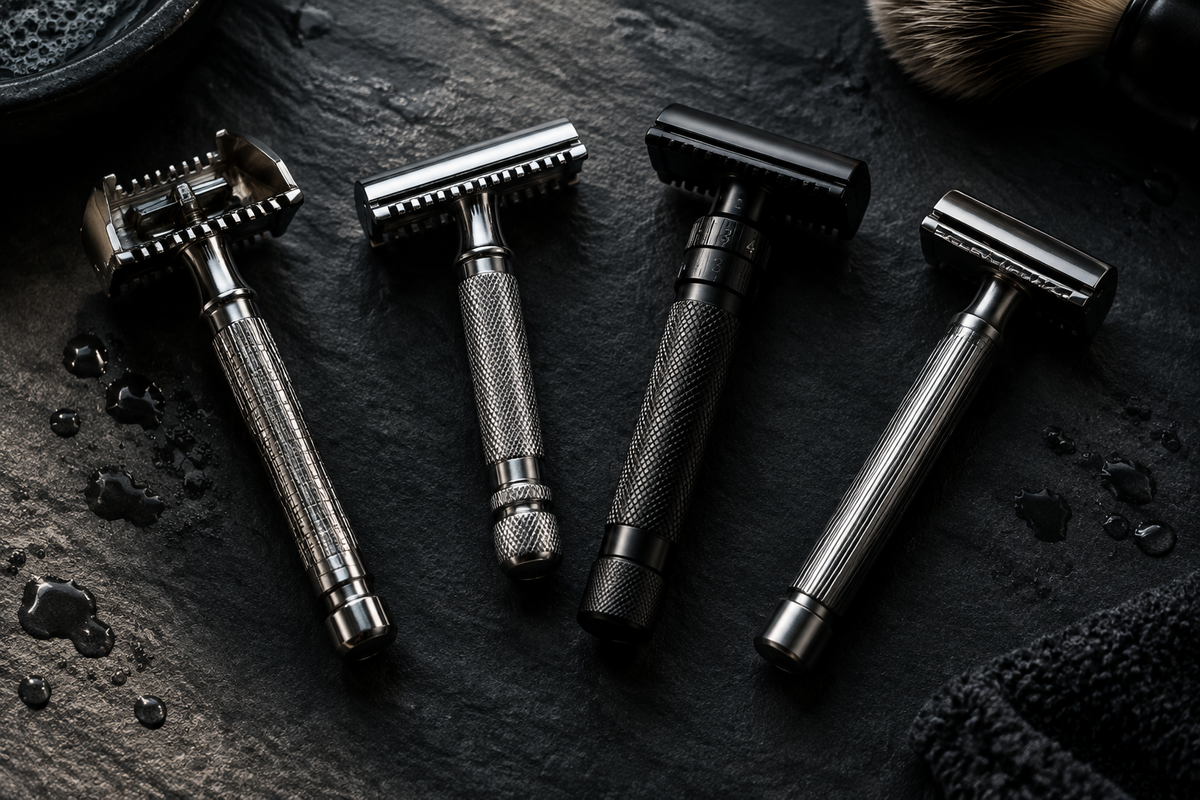
The four types of safety razors are the closed comb razor, the open comb razor, the slant-head razor, and the adjustable razor. They all use the same double-edge blade, but they don't shave the same way at all. It all comes down to the razor head: how much of the blade is exposed, the cutting angle, and how lather and hair move through it.
This detail matters more than you might think. When a first safety razor shave goes badly, technique is rarely the only cause. More often, the razor type simply doesn't match the skin or beard of the person holding it.
What really sets one safety razor apart from another
Before comparing models, you need to understand a notion that traditional shaving enthusiasts call aggressiveness. An aggressive razor exposes more of the blade and leaves a larger gap between the blade and the guard bar. It cuts more hair per pass, but it forgives angle and pressure mistakes less.
A mild razor does the opposite: it protects the skin, sometimes needs an extra pass, and leaves much more room to learn. Neither is better. The right question is which one suits your skin, your beard and your shaving rhythm.
1. The closed comb razor: the safest starting point
The closed comb is the most common type. Under the blade, a continuous bar (often lined with small grooves) stretches the skin just before the edge passes. The result: the blade stays well guided and the risk of cuts goes down.
It's the most logical choice if you're starting out, shave every day, or have skin that reacts easily. It also works very well for people leaving multi-blade razors who want a transition without surprises. Its limit shows up with a multi-day beard: long hairs tend to build up in the head and the razor can seem to clog.
In this category, the Merkur 34G HD closed comb is a classic, appreciated for its weight, which does much of the work for you. Butterfly-opening razors follow the same logic, with an even simpler blade loading.
2. The open comb razor: built for dense or longer beards
Here, the continuous bar is replaced by a row of teeth, like a real comb. These teeth lift and guide the hair toward the blade while letting the lather through. The head stays clear even when the beard is a few days old.
The open comb is more effective on dense beards and for those who shave every two or three days. In return, the blade is more exposed. On sensitive skin, or with a technique that is still hesitant, it can cause redness and small cuts.
The Merkur 25C open comb razor is a good example: its teeth guide long hairs straight to the blade without clogging the head.
3. The slant-head razor: an angled cut for coarse hair
On a slant razor, the head is slightly twisted, so the blade meets the hair diagonally rather than head-on. This twist stiffens the blade and produces a sliding cut, a bit like a guillotine. Coarse, dense hair is cut more cleanly, often in fewer passes.
It's the razor of thick beards and of shavers who already master the basic angle. Some sensitive skins even appreciate it, precisely because it reduces the number of passes. But this benefit only appears with good technique. In the hands of a beginner, a slant can quickly feel harsh.
For a gentler first approach, the Parker 55SL-GR semi-slant razor is a good middle ground between a closed comb and a full slant.

4. The adjustable razor: one razor, several levels of aggressiveness
The adjustable razor lets you change the gap between the blade and the guard bar, and therefore its aggressiveness. Depending on the model, you turn a dial under the head or swap a plate. You go from a mild shave to a sharper one without changing tools.
It's a smart option if you're torn between two types, if your beard varies from one shave to the next, or if your skin changes with the seasons. In Quebec, winter dries out the skin: an adjustable razor lets you turn it down a notch when skin feels tight, then turn it back up in spring. It only takes a bit of experimenting to find your setting.
The Rockwell T2 Gunmetal adjustable razor is set with a dial, while the Rockwell 6S relies on interchangeable plates. Parker's variable-setting models work on the same principle.

Butterfly, two-piece or three-piece: the mechanism matters less than the head
People often confuse razor types with their assembly mechanism. There are three:
- One piece (butterfly or “twist-to-open”): you turn the bottom of the handle and the head opens to receive the blade. It's the fastest to load.
- Two pieces: the top plate unscrews, while the handle and base stay fixed together.
- Three pieces: plate, base and handle separate completely. It's the easiest to clean thoroughly.
This choice mostly affects ease of use and maintenance, not shave quality. A butterfly razor can be closed comb, a three-piece can be open comb. Choose the head first, then the mechanism you like.
Why the wrong choice can ruin your shave
An ill-suited razor doesn't just give an average shave. It can put you off traditional shaving altogether. Here are the mistakes that come up most often.
A razor too aggressive for your skin
It's the classic beginner mistake: picking a slant or an open comb because it “shaves closer”. The result: redness, razor burn and cuts within the first weeks. If that sounds familiar, our article on how to avoid razor burn and irritation covers the right habits. For small cuts, always keep a styptic pencil within reach to stop bleeding in seconds, or an alum block that tightens pores and soothes the skin after shaving.
A razor too mild for your beard
The opposite mistake exists too. A very mild closed comb on a tough beard forces you to go over the same spot three or four times. Every pass adds friction, and irritation ends up arriving anyway. If your razor pulls instead of cutting, it isn't always the blade that's worn: the razor type may simply be undersized for your hair.
An unbalanced razor and blade combination
The razor and the blade work together. An aggressive head combined with a very sharp blade like the Feather can be too intense for most skin types. Conversely, a mild razor with a mild blade can lack bite. Our guide to choosing the right blade for your razor explains how to balance the two.
A shaving product that doesn't protect enough
Even the ideal razor gives a poor result on poorly lubricated skin. A quality shaving cream or a well-whipped shaving soap protects the skin and reduces friction on the blade. Bonus: the more lubricating the lather, the less the blade wears, which extends its life.
Which type of safety razor to choose based on your profile
| Your profile | Type to favor | Why |
|---|---|---|
| You're a beginner or leaving multi-blade razors | Closed comb | Forgiving, it gives you time to learn the right angle |
| Sensitive skin, frequent redness | Closed comb or adjustable on a low setting | Less exposed blade, less irritation |
| Shaving every two or three days, dense beard | Open comb | Teeth guide long hairs without clogging the head |
| Coarse, dense hair, technique already mastered | Slant head | Cleaner angled cut, fewer passes |
| You want one razor that grows with you | Adjustable | Aggressiveness adjusts to skin, beard and season |
If you're starting from scratch, our guide to the best starter kits for classic shaving helps you put together the razor, brush and soap in one go. And if you're still torn between the blade and the device, our comparison safety razor or electric shaver based on your lifestyle will help you decide.
Handle and weight: the details that change the feel
Once you've chosen the head type, two details make the difference day to day. The handle first: a long handle gives more control to larger hands, while a short one is easier to handle around the nose and jaw. Then weight: a heavy razor glides with less pressure, which limits cuts. With a safety razor the rule never changes: you don't press, you let the weight do the work.
Frequently asked questions about safety razor types
Which safety razor should I choose as a beginner?
A closed comb razor, ideally a fairly heavy one. It protects the skin while you learn the shaving angle (about 30 degrees) and forgives small pressure mistakes. You can always move up to a more aggressive or adjustable model later.
“Rasoir de sûreté” or “rasoir de sécurité”: what's the difference?
None. Both French terms describe the same double-edge razor, whose head only exposes a small portion of the blade. “Rasoir de sûreté” is the more common expression in French, while “rasoir de sécurité” is a more literal translation of the English “safety razor”.
Do all blades fit all safety razors?
Yes. Double-edge blades are universal and fit every type presented here, from closed comb to adjustable. What changes is the result: the same blade will feel milder in a closed comb than in a slant.
Is a safety razor suitable for sensitive skin?
Yes, often better than a multi-blade razor, since only one blade passes over the skin with each stroke. The secret is to choose a closed comb or an adjustable on a low setting, prepare the skin well, and never force it.
Closed comb, open comb, slant or adjustable: each type has its place, as long as you choose it for your skin and your beard rather than for its reputation. Compare the models in our safety razor collection and find the one that will make your shave enjoyable from the very first time.


