


 Make an appointment
 Buy a gift card
 Find a branch
 Reload a gift card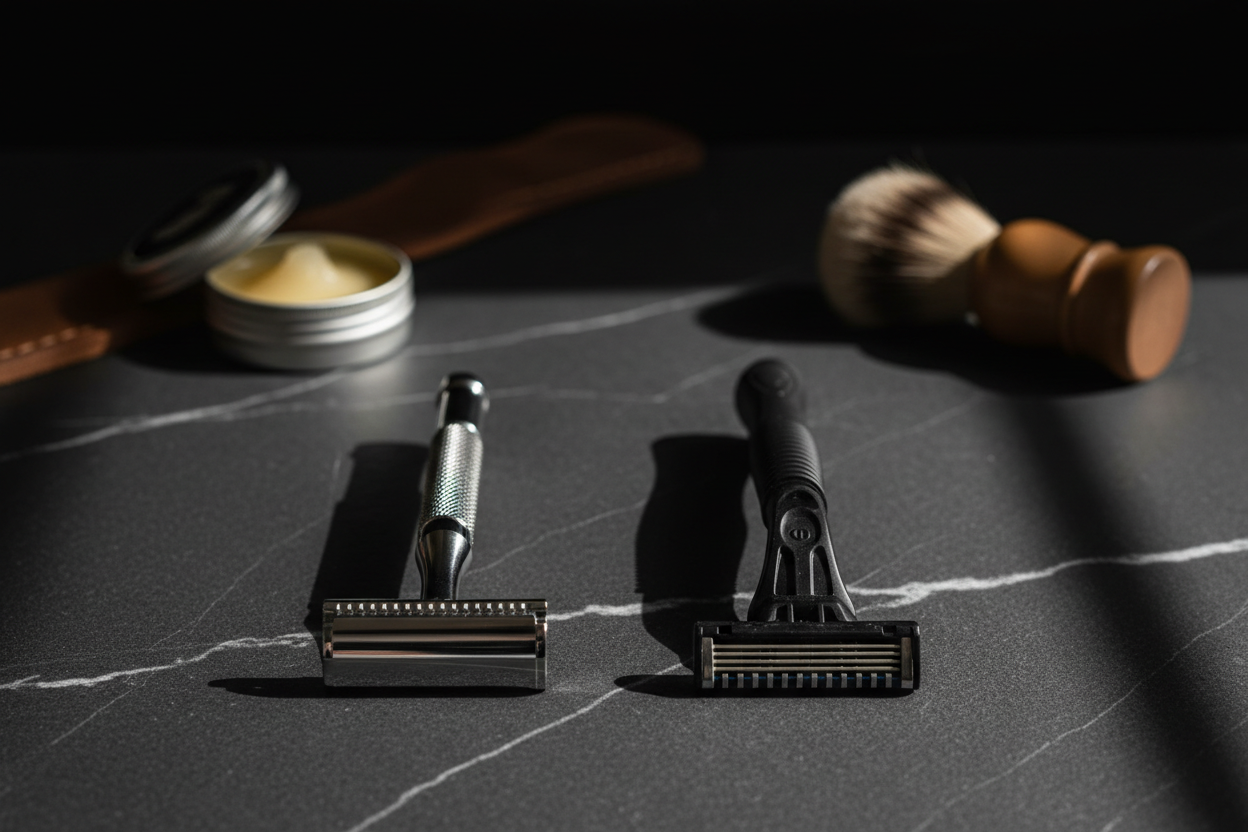
This debate comes up often. On one side, those who swear by the safety razor and its double-edge blades. On the other, those who have been using a Gillette cartridge for twenty years and have no reason to change. Both are right, depending on their situation.
Here's a direct comparison of the five factors that truly matter: shaving, skin, cost, environment, and ease of use.

How both systems work
Double-Edge (DE) Blade
This is a thin stainless steel blade, sharp on both sides, which is inserted into a safety razor. A single blade, exposed on each side of the head. Shaving is done at 30 to 45 degrees, with little to no pressure. The blade cuts the hair in a single clean pass.
Cartridge Blade
A plastic cartridge containing 3 to 5 stacked blades, often accompanied by a lubricating strip and a flexible comb. The head pivots with facial movements, the angle is pre-set, and the shave is designed to require no particular technique.
The Shave: Quality and Result
Double-edge blades generally provide a cleaner, closer shave with less irritation when the technique is mastered. A single sharp blade cuts the hair at the base without pulling it. The blades do not overlap, and hairs are cut before being pulled out.
Cartridge razors are more forgiving. The flexible head compensates for bad angles, the comb prepares the skin, and the strip lubricates. The result is good, but the 3 to 5 blades passing consecutively over the same area create more friction. For sensitive skin, this cumulative passing can be the source of redness and bumps that appear regularly after shaving, without the cause being identified.
Verdict: The double-edge blade shaves better when the technique is there. The cartridge is more forgiving for beginners' mistakes.
Skin: Irritation, Ingrown Hairs, Comfort
This is where the difference is most noticeable.
With a 5-blade cartridge, each pass covers the same area with 5 successive blades. In practice, on a 5 cm area shaved three times, there are 15 blade-to-skin contacts. For sensitive skin or men who suffer from chronic ingrown hairs, this volume of contact is often the direct cause of the problem. The blade slightly pulls the hair before subsequent ones cut it, which can cause it to grow back under the skin.
A double-edge blade, used correctly, passes only once. The contact is clean, without pulling. Ingrown hairs and chronic irritation are significantly less common in men who make the switch.
That said, there is a learning curve. The first few weeks with a safety razor can cause more irritation than a cartridge, if the angle or pressure is not yet mastered.
Verdict: The double-edge is better for the skin in the long run. The cartridge is more comfortable during the learning phase.

Cost: What it really costs over a year
Here are the figures for a man who shaves 3 to 4 times a week in Quebec.
| Double-Edge Blade | Gillette Mach3 Cartridge | Gillette Fusion5 Cartridge | |
|---|---|---|---|
| Price per blade | $0.15 to $0.60 | ∼$3.50 to $5 | ∼$5 to $7 |
| Shaves per blade | 4 to 7 | 6 to 10 | 6 to 10 |
| Annual cost (3x/week) | $15 to $30 | $80 to $130 | $120 to $180 |
The safety razor itself costs between $30 and $80 CAD depending on the model — a one-time purchase that lasts for years, often a lifetime if well-maintained. The cartridge, on the other hand, costs almost nothing for the handle, but the blades are one of the most expensive everyday consumer products per litre in North America.
The difference over a year is real. Over ten years, it is considerable.
Verdict: The double-edge is significantly cheaper to use, even including the initial cost of the razor.

Environment: What we actually throw away
A DE blade is entirely made of metal. It is placed in a used blade collector (a metal box that costs a few dollars) before going to recycling. No plastic.
A cartridge combines metal, rigid plastic, rubber, and sometimes glue. It is not recyclable in most municipal programs in Quebec. Billions of cartridges end up in landfills every year worldwide.
This is a criterion that is increasingly weighing on purchasing decisions, especially among men aged 25 to 40 who are looking to reduce their impact without sacrificing shaving quality.
Verdict: The double-edge is significantly more sustainable and less polluting.
Ease of Use: Learning Curve and Daily Life
This is the only area where the cartridge clearly wins.
With a cartridge, there's nothing to learn. Apply the foam, shave, rinse. The angle is pre-set, the head compensates for imprecise movements. Two minutes, no cuts, acceptable results.
The safety razor requires an adaptation period of two to four weeks. You need to learn not to press (the weight of the razor is enough), to maintain the correct angle, and to read the blade's resistance. Once these reflexes are acquired, shaving becomes intuitive and often more pleasant than with a cartridge. But during the first few weeks, mistakes result in irritation.
Verdict: The cartridge is simpler for daily use. The double-edge requires initial learning but rewards patience.
Summary Comparison Table
| Criterion | Double-Edge | Cartridge |
|---|---|---|
| Shaving Quality | Excellent (with technique) | Good |
| Sensitive Skin Comfort | Better in the long run | Better during the learning phase |
| Ingrown Hairs | Less frequent | More frequent |
| Annual Cost | $15 to $30 | $80 to $180 |
| Environment | Recyclable (metal only) | Not recyclable (mixed materials) |
| Ease of Use | Learning required | Immediate |
| Universal | Yes (all brands compatible) | No (proprietary system) |
Who should choose what
Stick with the cartridge if: you're in a hurry in the morning, you shave difficult areas (shaved head, complex contours), or you're a beginner and prefer no learning curve. The cartridge remains a valid option — but if irritation or cost starts to be a concern, the double-edge is seriously worth trying.
Switch to double-edge if: you have chronic irritation or ingrown hairs, you want to reduce your annual shaving cost, you're looking for a cleaner and closer shave, or the environmental aspect matters in your consumer choices.

For those who want to test, the simplest way is to start with a few packs of different brand blades before committing to one brand. Our selection of double-edge razor blades covers several levels of aggressiveness, mild, medium, and intense, to find what suits your beard and skin.
If you don't know which blade to start with, our complete guide to choosing the right razor blade covers types, brands, and sharpness levels in detail.
Frequently Asked Questions
Can different brands of blades be used in a safety razor?
Yes. This is one of the great advantages of the double-edge format: all DE blades are universal. A Derby, Astra, or Feather blade fits any safety razor, regardless of the handle brand.
Does the safety razor cut more easily?
Not necessarily. It cuts differently. A single very sharp blade directly against the skin, rather than multiple blades protected by strips and combs. Shaving is more precise but requires a little more attention to the angle.
Is it easier to bleed with a safety razor?
During the first few weeks, yes, if too much pressure is applied or if the angle is not right. With good technique, cuts are rare. Most cuts in traditional shaving come from excessive pressure, not the blade itself. If you do cut yourself, a styptic pencil or alum block stops the bleeding in a few seconds — two simple products to have in your shaving kit.
Is the double-edge blade suitable for acne-prone skin?
Yes, often better than the cartridge. Fewer passes over the same area mean less irritation of existing pimples. The important thing is to use a quality shaving cream or soap, alcohol-free, and not to shave over inflamed areas.
Do you have a thick beard, sensitive skin, or are you still unsure which blade to choose? Check out our collection of razor blades available online.


